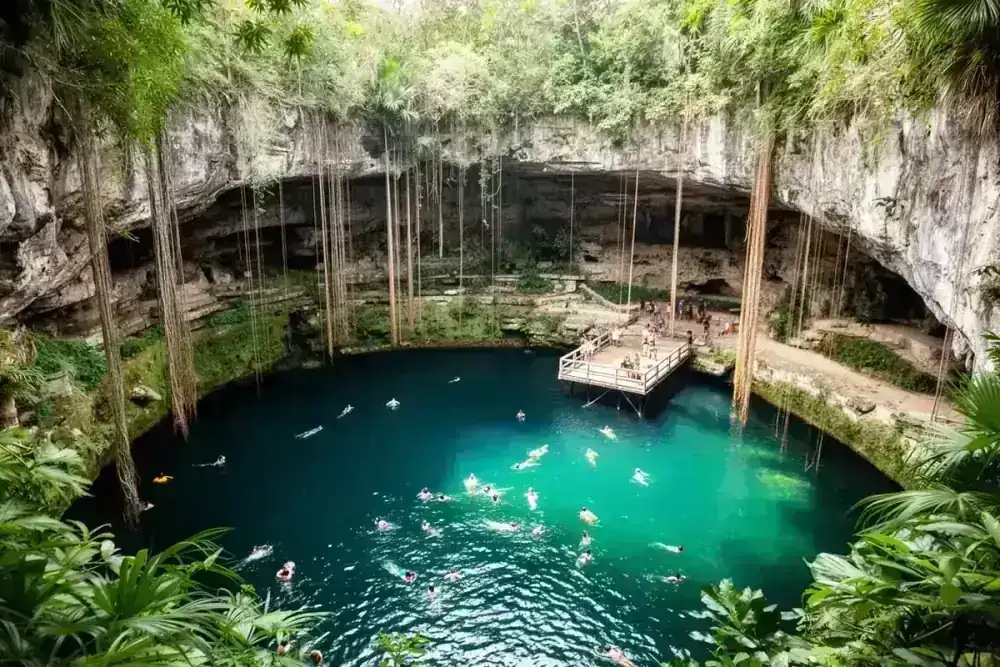
What Is a Cenote?
A cenote is a natural sinkhole formed when Yucatan's limestone roof collapses and exposes the groundwater below. The Maya used them for drinking water and ritual; today most are swimming spots, from open pools to enclosed caves.
A cenote (pronounced seh-NO-tay) is a natural freshwater sinkhole formed when porous limestone bedrock collapses and exposes the groundwater beneath. Cenotes are found mostly across Mexico's Yucatan Peninsula, where thousands dot the jungle. The ancient Maya treated them as sacred water sources, and today they draw visitors for swimming, snorkeling, and diving.
The natural freshwater sinkholes that shaped Maya life across the Yucatan Peninsula.
What does the word "cenote" mean?
The word cenote comes from the Yucatec Maya term ts'ono'ot (also written dzonot), which translates roughly to "well" or "cavern with water." The Maya used it for any natural opening that reached the groundwater below the limestone surface. Spanish speakers later adapted the word to "cenote," and today it describes the freshwater sinkholes found throughout the Yucatan Peninsula and parts of Central America.
Cenotes are pronounced seh-NO-tay in the singular and seh-NO-tays in the plural. You will also see the Spanish plural "cenotes" used on maps and signs across the region.
How do cenotes form?
Cenotes form when acidic rainwater slowly dissolves the soft limestone bedrock that makes up the Yucatan Peninsula, carving out underground caves and river systems over millions of years. When the roof of one of these caves grows too thin, it collapses and opens a window to the clear groundwater below. That opening is a cenote.
The Yucatan is unusually rich in cenotes because of its geology. The peninsula sits on a vast, porous limestone shelf, and much of that rock was fractured by the Chicxulub asteroid impact roughly 66 million years ago, the same event linked to the extinction of the dinosaurs. The fractured rock helped create the enormous network of underground rivers and caves that feed the region's cenotes today. Because the Yucatan has almost no surface rivers, this underground water system is the peninsula's main source of fresh water.
The three types of cenotes
Cenotes are usually grouped into three types based on how much the cave roof has collapsed, which also tends to reflect their age. Older cenotes are more open; younger ones stay enclosed underground.
| Type | What it looks like | Example |
|---|---|---|
| Open | The cave roof has fully collapsed, leaving a large open-air pool ringed by jungle. The oldest type. | Cenote Ik Kil, near Chichen Itza |
| Semi-open | The roof has partly collapsed, so rock overhangs the water and sunlight beams in through gaps in the ceiling. | Cenote Suytun, near Valladolid |
| Cave | Fully enclosed underground, reached through a small opening or staircase, often filled with stalactites. The youngest type. | Cenote Xkeken (Dzitnup) |
Open cenotes feel like natural swimming pools and are the easiest for families. Semi-open cenotes are the ones you see in photographs, with light beams cutting through the cavern. Cave cenotes are darker and more dramatic, and some connect to long underwater cave systems used by experienced divers, such as Cenote Dos Ojos near Tulum.
If you are deciding which to visit, the best cenotes in Yucatan guide compares specific sites by area, route, and swim style. You can also see cenotes near Chichen Itza if you want to pair one with the ruins.
Why were cenotes sacred to the Maya?
Cenotes were sacred to the ancient Maya because they were the main source of fresh water in a land with no surface rivers, and because the Maya believed they were entrances to the underworld. They called that underworld Xibalba, a place ruled by the gods of death, and they saw the still, deep water of a cenote as a doorway to it.
The Maya performed ceremonies at cenotes and left offerings in the water, from pottery and jade to, at some sites, human sacrifices. The most famous example is the Sacred Cenote at Chichen Itza, a large open cenote inside the ancient city where divers have recovered thousands of ritual objects. This link between water, the gods, and the underworld is one reason cenotes still feel otherworldly to visitors today.
What are cenotes used for today?
Today cenotes are used mainly for tourism and recreation. Travelers swim, snorkel, and dive in them, and the clearest cave cenotes have become world-famous among cave divers. Beyond tourism, cenotes still supply fresh water to parts of the Yucatan, and scientists study them for the fossils, artifacts, and rare ecosystems preserved in their still water.
For most visitors, a cenote is a place to cool off after a hot morning at the ruins. A swim in Cenote Ik Kil, which sits about 3 km from Chichen Itza, roughly five minutes by car, is a common stop right after a Chichen Itza and cenote tour.
How many cenotes are in the Yucatan?
Estimates range from about 6,000 to 10,000 cenotes across the Yucatan Peninsula, and some geologists believe the true number could be far higher once unmapped sites are counted. Within the state of Yucatan alone, tourism authorities track roughly 10,000. Only about 140 to 200 are officially developed for public swimming and diving, which means the large majority remain unexplored or sit on private land.
Are cenotes safe to swim in?
Cenotes are generally safe to swim in when you follow basic precautions, such as wearing a life jacket if you are not a strong swimmer, taking care on wet stone steps, and skipping sunscreen to protect the water. Because many cenotes are deep and some are enclosed, a little preparation goes a long way. For the full rundown on depth, gear, family swimming, and what to bring, read the cenote safety guide.
Frequently Asked Questions About Cenotes
See a cenote for yourself
Many travelers see their first cenote right after visiting the ruins, since Cenote Ik Kil sits minutes from Chichen Itza. If you want help choosing a cenote that fits your route and travel style, the local team can plan it with you.
Plan a cenote stop on WhatsApp