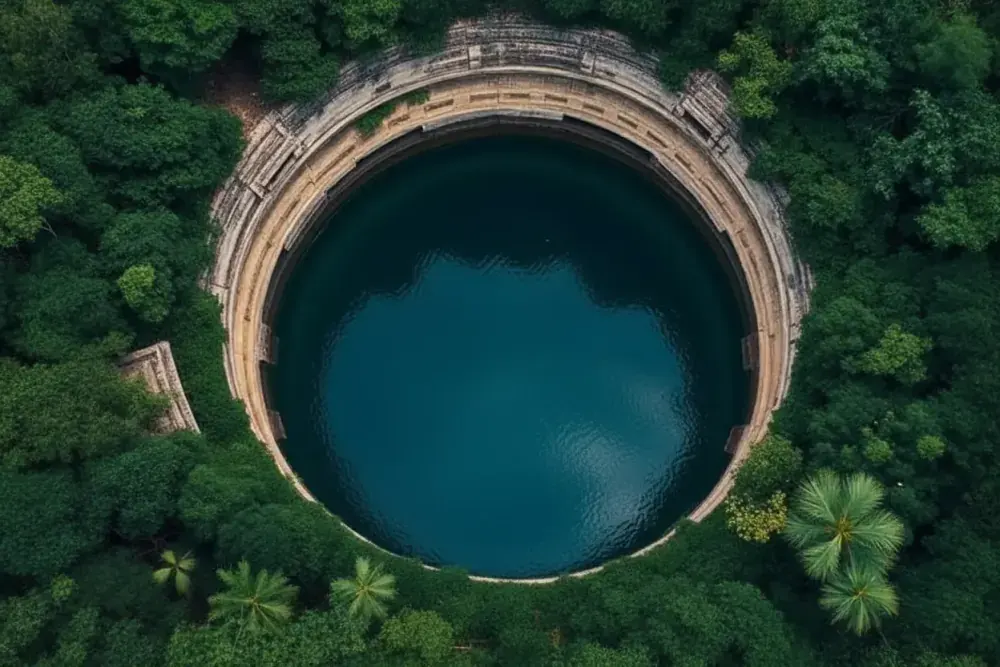
The Sacred Cenote of Chichen Itza
The Sacred Cenote at Chichen Itza is a 60-metre-wide natural well north of El Castillo, linked to it by a stone causeway. It was used for offerings to the rain god Chaac, not for swimming, and remains closed to visitors.
The Sacred Cenote, or Cenote Sagrado, is a natural sinkhole at Chichen Itza that the Maya treated as a sacred portal to Xibalba, the underworld. About 60 meters (200 feet) across and 22 meters (72 feet) deep, it was a place of ritual offerings and human sacrifice to the rain god Chaac, not a source of drinking water. Swimming in it is not allowed.
What is the Sacred Cenote?
The Sacred Cenote is a large, water-filled limestone sinkhole at the north end of Chichen Itza. Unlike the region's many swimming cenotes, the Maya did not use it for water. They saw it as a doorway to Xibalba, the underworld, and a place to reach the gods, above all Chaac, the god of rain. For how these sinkholes form across the Yucatan, read what a cenote is.
Where is the Sacred Cenote, and how do you reach it?
The Sacred Cenote sits about 300 meters north of the main plaza at Chichen Itza, linked to the center of the city by a raised stone causeway called a sacbe. Visitors reach it on a short walk from El Castillo, the main pyramid. The sinkhole measures about 60 meters (200 feet) across, with sheer walls dropping to green water roughly 22 meters (72 feet) below the rim.
Why was the Sacred Cenote sacred?
The Maya believed cenotes were entrances to the underworld, and the Sacred Cenote was the most important of them. It was a pilgrimage site where priests made offerings to Chaac to bring rain and good harvests, and where the community marked times of drought and crisis. Pilgrims traveled from across the Maya world to leave gifts here, which is part of why so much was recovered from its depths.
Offerings Recovered from the Sacred Cenote: Gold, Jade and More
Archaeologists have recovered a vast store of offerings from the Sacred Cenote: gold and copper bells and jewelry, carved jade, turquoise traded from as far as Guatemala, pottery, copal incense, and rare organic items such as textiles and carved wood. Alongside the objects lie the remains of more than 200 people. The cenote is one of the greatest single collections of Maya offerings ever found, and the artifacts reveal trade networks that stretched across Mesoamerica.
Sacrifice at the Sacred Cenote: What the Evidence Shows
Yes. The Maya cast both precious objects and human beings into the Sacred Cenote as offerings to Chaac, especially in times of drought. Early accounts claimed the victims were young maidens, but the remains recovered from the cenote include men, women, and many children of all ages. Recent DNA research at Chichen Itza found that sacrificed children were mostly boys, several of them closely related, including sets of identical twins, a striking echo of the Hero Twins in the Popol Vuh. The old story of sacrificed virgins is now considered a myth.
Who dredged the Sacred Cenote?
The first major recovery was led by Edward Herbert Thompson, the US consul in the Yucatan, who dredged and dove the cenote between 1904 and 1910 with funding from Harvard's Peabody Museum. Thompson shipped many of the gold and jade finds out of Mexico, a removal later challenged as illegal, and some pieces were eventually returned. Scientific study of the cenote has continued through the decades since.
Swimming Rules at the Sacred Cenote
No. The Sacred Cenote is preserved for its history and cannot be entered or swum in. Its walls are sheer, its water is deep and clouded with sediment and vegetation, and it is protected as an archaeological site. Many photos labeled as the Sacred Cenote actually show Ik Kil and other swimmable cenotes nearby. For cenotes you can swim in around Chichen Itza and the Yucatan, see the cenotes guide.
Seeing the Sacred Cenote today
The Sacred Cenote is a stop inside the Chichen Itza archaeological zone, reached by the old sacbe causeway a short walk from El Castillo. It is a viewing site rather than a swimming spot, and its meaning is best understood with the history of the offerings in mind. Plan the site hours, tickets, and route on the Chichen Itza destination guide. It remains one of the most studied sites across the Yucatan's Mayan ruins.