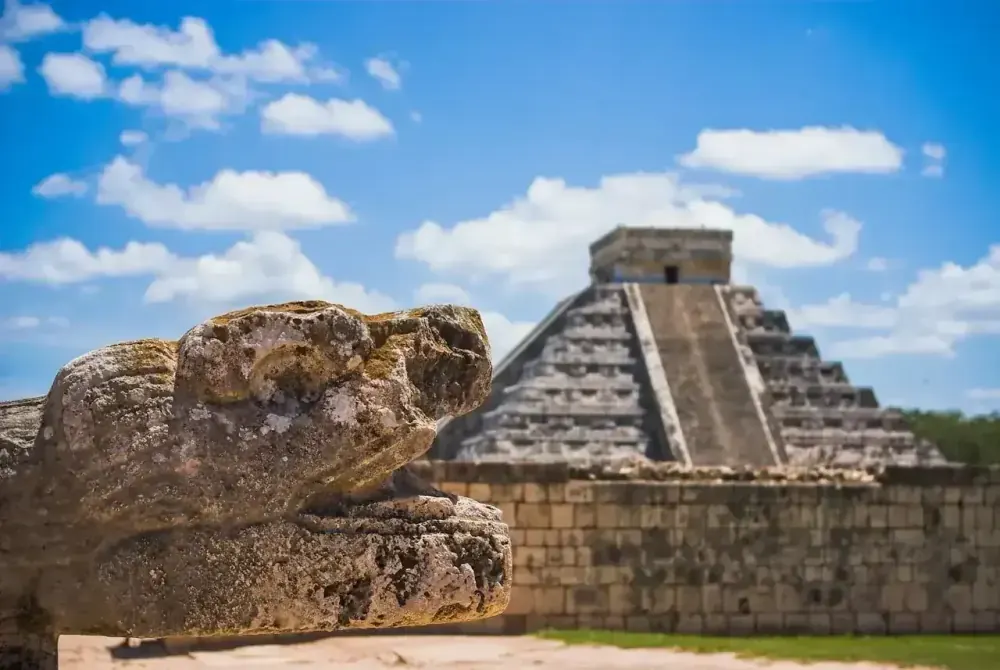
El Castillo: The Temple of Kukulkan at Chichen Itza
El Castillo is the main pyramid of Chichen Itza: nine terraces, four stairways of 91 steps and a temple on top, 365 steps in total for the solar year. It is closed to climbing, so plan to view and photograph it from the plaza.
El Castillo, also called the Temple of Kukulkan, is the main pyramid at the center of Chichen Itza in Yucatan, Mexico. The stepped limestone pyramid stands about 30 meters (98 feet) tall, carries 365 steps for the days of the solar year, and stages a serpent-shadow illusion at each equinox. El Castillo is not the whole city, only its most famous structure.
What is El Castillo?
El Castillo is the name Spanish visitors gave the largest pyramid at Chichen Itza. The Maya built it as the Temple of Kukulkan, the feathered serpent. The pyramid is also called the Kukulkan Pyramid or the Pyramid of Kukulcan. It is one structure inside the ancient city, not the city itself: Chichen Itza is the full archaeological site, and El Castillo is its centerpiece pyramid and the reason the site was voted one of the New Seven Wonders of the World.
The pyramid sits on the main plaza and was raised in stages over older structures. To understand who the pyramid honors, read about Kukulkan, the feathered serpent deity. To see how it fits into the wider site, plan with the Chichen Itza destination guide. The site also includes the Great Ball Court.
How tall is El Castillo, and how is it built?
El Castillo stands about 30 meters (98 feet) to the top of its summit temple, with the stepped platform rising roughly 24 meters (79 feet). It is a square pyramid about 55 meters (181 feet) on each side, built as nine stacked terraces with a staircase climbing each of the four faces to a temple on top.
Stone balustrades flank every staircase. At the foot of the north stairway sit two colossal feathered-serpent heads, effigies of Kukulkan. The temple doorway at the summit is framed by serpent columns and topped with a mask of Chaac, the Maya rain god. The design is deliberate and mathematical, which is why El Castillo is studied as much for its astronomy as for its scale.
Why El Castillo Has 365 Steps: The Calendar in Stone
El Castillo has 365 steps because each of its four staircases holds 91 steps, and the shared platform at the summit adds one more: 91 times 4, plus 1, equals 365, one step for every day of the solar year. The pyramid was built as a calendar in stone.
The count of steps is only the clearest of the calendar references worked into the pyramid. Its nine terraces, split by each staircase, read as eighteen sections that echo the eighteen months of the Maya solar year. For how these cycles actually worked, read the Maya calendar guide.
The equinox serpent: Kukulkan's descent
At the spring and autumn equinoxes, the late-afternoon sun strikes the northwest edge of El Castillo and casts a row of triangular shadows down the western side of the north staircase. The shadows line up with the carved serpent heads at the base, creating the illusion of a feathered serpent gliding down the pyramid. The effect is built into the pyramid's angles and orientation, not an accident of a single date.
The descending serpent represents Kukulkan returning to earth, tying the building's astronomy to Maya belief. For the exact dates, the best time of day, and how to see the shadow around the crowds, read the Chichen Itza equinox guide.
What Is Inside El Castillo: The Hidden Inner Temple
El Castillo is a pyramid within a pyramid within a pyramid. The pyramid visitors see today was built over an older pyramid, which in turn covers a third, smaller one. Inside the second pyramid, archaeologists found a throne carved as a jaguar, painted red and inlaid with jade, along with a Chac Mool figure used to hold offerings.
The innermost pyramid was confirmed in 2016 using electrical imaging that mapped the hidden structures without digging. Each layer shows how Maya rulers reused sacred ground, raising a new temple over the last to reinforce their authority.
The Cenote Beneath El Castillo
Yes, a cenote sits directly beneath El Castillo. In 2015, researchers detected a water-filled cenote hidden directly beneath El Castillo, using electrical imaging that reads the ground under the pyramid. The sinkhole sits below the foundations, connected to the underground rivers that run through the Yucatan limestone.
Many archaeologists believe the Maya chose this exact spot on purpose, placing the temple above water to link it with the underworld and mark the center of their world. It also fits the meaning of the name Chichen Itza, "at the mouth of the well of the Itza."
Climbing El Castillo: Closed Since 2006
No. Climbing El Castillo has been prohibited since 2006, after a visitor died in a fall from the pyramid. Visitors can walk the full base and photograph the pyramid from every side, but the staircases are closed to protect both the stone and the public.
For travelers who want to climb a Maya pyramid, Nohoch Mul at Coba reopened to climbers in December 2025, and the Acropolis at Ek Balam remains open. Both are close enough to combine with Chichen Itza.
Why do people clap in front of El Castillo?
A sharp clap at the base of El Castillo's staircase produces a chirped echo that resembles the call of the quetzal, a bird sacred to the Maya. Acousticians who have measured the effect regard it as deliberate design rather than coincidence, another link between the pyramid and Kukulkan, the feathered serpent.
How old is El Castillo, and who built it?
El Castillo was built by the Maya of Chichen Itza between roughly the 9th and 12th centuries AD, during the city's peak as a regional capital. It rose in stages over earlier temples on the same spot, in a style that blends Maya tradition with central Mexican (Toltec) influence.
El Castillo is one of the finest structures across the Yucatan's Mayan ruins, and the anchor of the whole Chichen Itza plaza. For the full story of who built the city and why it declined, read the history of Chichen Itza.
Seeing El Castillo today
El Castillo stands at the center of the Chichen Itza archaeological zone and is the first structure most visitors reach through the main entrance. Because climbing is closed, the best experience is a slow walk around all four sides with the astronomy and history in mind. Plan the site hours, tickets, and route on the Chichen Itza destination guide.