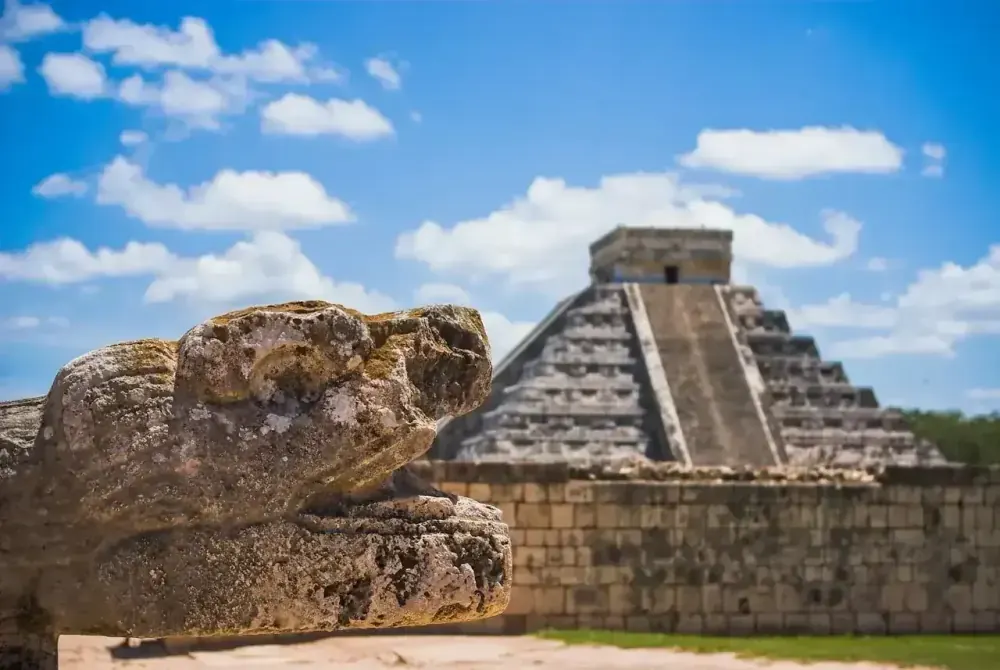
Kukulkan: The Feathered Serpent God of Chichen Itza
The Kukulkan pyramid, El Castillo, is the 30-metre step pyramid at the centre of Chichen Itza, dedicated to the feathered serpent Kukulkan. At the equinoxes its northern stairway casts a serpent-shaped shadow. Climbing is not permitted.
Kukulkan is the feathered serpent deity of the ancient Maya, worshipped across the Yucatan Peninsula as a god of wind, rain, and knowledge. At Chichen Itza, the pyramid known as El Castillo was built as his temple, and its famous equinox shadow illusion recreates his descent down the northern staircase.
Who Is Kukulkan?
Kukulkan appears in Maya religion from the Classic Period onward as a feathered serpent, part bird and part snake, a combination that represented the union of sky and earth. Maya communities associated him with the wind that arrives before rain, with the planet Venus, and with the transfer of knowledge between gods and people.
Some later Maya and colonial-era accounts also describe Kukulkan taking human form, as a ruler-priest associated with Chichen Itza's founding or early leadership. Historians treat this as a separate, more historical strand from the deity mythology, and the two are often discussed together without being fully reconciled.
He was not a minor figure. Kukulkan ranked among the most important deities at Chichen Itza, and the city's largest structure was raised specifically in his honor.
The feathered serpent motif itself predates Kukulkan by centuries and appears across Mesoamerica under different names in different cultures. What makes Chichen Itza distinct is that its central pyramid, El Castillo, was purpose-built as this god's temple, and the building itself was engineered to perform a visual tribute to him twice a year.
What Is Kukulkan the God Of?
Kukulkan is most closely tied to wind and rain, the forces that governed the Maya agricultural calendar, as well as to knowledge and learning. Some inscriptions also link him to Venus and to royal authority, since Maya rulers sometimes invoked serpent imagery to claim divine legitimacy.
Kukulkan and El Castillo: The Temple Built in His Honor
El Castillo, the pyramid that dominates Chichen Itza's main plaza, carries two other names travelers will see used interchangeably: the Temple of Kukulkan, and simply the Kukulkan Pyramid. The structure's design encodes the Maya calendar across its staircases, terraces, and panels, a detail covered in full in our Mayan calendar guide. What matters for Kukulkan himself is simpler: this was his house. Stone serpent heads flank the base of the northern staircase, and a serpent-scale motif runs up the balustrades, marking the pyramid as sacred ground for this specific god rather than a generic monument.
The Descent of Kukulkan: Why a Serpent Appears on the Pyramid
Twice a year, for a few afternoon hours around the spring and fall equinoxes, sunlight strikes the nine tiered platforms of El Castillo at an angle that casts a jagged, triangular shadow down the edge of the northern staircase. That shadow lines up with the carved serpent heads at the base, and together they form the illusion of a massive snake slithering down the pyramid toward the earth.
Maya builders did not create this by accident. The alignment reenacts Kukulkan's descent from the sky, a deliberate piece of religious architecture rather than a coincidence of geometry. The effect is only visible during a roughly 72-year window, running from 1976 to 2048, after which the sun's position relative to the pyramid will have shifted enough to break the illusion. The year 2012, often mistakenly tied to Maya prophecies of doom, sits at the exact midpoint of this window, a detail that has nothing to do with the Maya Long Count calendar and everything to do with basic solar geometry.
For exact dates, timing, and where to stand for the best view, see our Chichen Itza equinox guide.
Kukulkan vs. Quetzalcoatl: Are They the Same God?
Kukulkan and Quetzalcoatl are widely treated as the same deity under two different names, and in broad strokes that is accurate. Both are feathered serpents associated with wind, rain, and knowledge. The difference is cultural origin. Kukulkan is the Yucatec Maya name, used at Chichen Itza and across the Maya lowlands. Quetzalcoatl is the Nahuatl name, used by the Aztecs and other central Mexican cultures centuries later and hundreds of miles away.
The two traditions developed independently before converging through trade and cultural exchange between the Maya and central Mexico. So while a visitor standing in front of El Castillo can accurately say they are looking at a temple to Kukulkan, calling it a temple to Quetzalcoatl would be describing the same underlying god through the wrong culture's name for him.
What Does the Name Kukulkan Mean?
Kukulkan translates roughly to "feathered serpent" or "plumed serpent" in Yucatec Maya, combining the word for quetzal feathers with the word for snake. The name is descriptive rather than mythological in origin, a literal label for the god's hybrid bird-and-serpent form. The name is also written Kukulcan and Kukulkán in English and Spanish sources.
Frequently Asked Questions About Kukulkan
See the Temple of Kukulkan in person
The clearest way to understand Kukulkan at Chichen Itza is to stand in front of El Castillo, see the serpent heads at the northern staircase, and hear how the temple connects religion, astronomy, and architecture. If you want help planning a visit, the local team can build a Chichen Itza day around your dates and travel style.
Plan a Chichen Itza visit on WhatsApp