The Mayan Calendar Explained
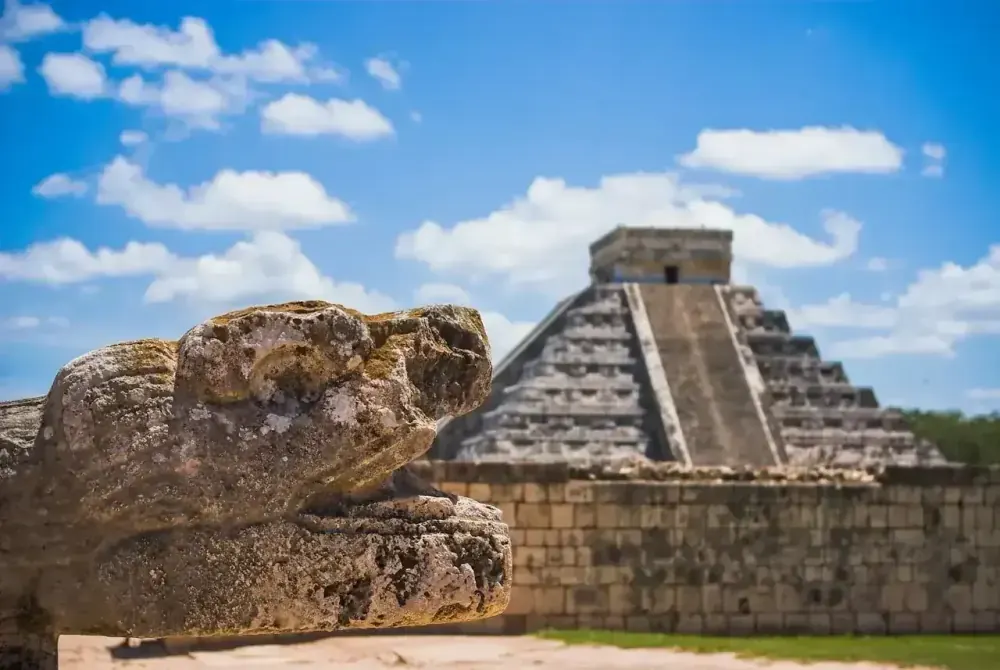
The Maya calendar interlocks a 260-day sacred Tzolk'in cycle with the 365-day Haab' year, and tracks longer spans with the Long Count. El Castillo at Chichen Itza encodes it: 365 steps and stairways that split the year.
The Mayan calendar is not a single calendar but a system of three interlocking cycles the ancient Maya used together: the Tzolkin, a 260-day sacred count, the Haab, a 365-day solar year, and the Long Count, which tracked long spans of history. The Maya were expert astronomers, and their calendars remain among the most accurate of the ancient world. The El Caracol observatory shows how watching Venus and the sun fed that system. You can still see the system built into the stone of Chichen Itza today.
How the ancient Maya tracked time with three interlocking calendars, and what really happened in 2012.
The three Maya calendars
The Maya kept time with three separate calendars at once, each with its own purpose. Rather than one line of years, the system worked like interlocking gears, and any important date was recorded in more than one calendar so it could never be confused.
| Calendar | Length | Purpose |
|---|---|---|
| Tzolkin | 260 days | The sacred count, used for ceremonies, divination, and naming children. It pairs 20 day-names with the numbers 1 to 13. |
| Haab | 365 days | The solar year, used for farming and civil life. It has 18 months of 20 days plus a short 5-day month called Wayeb. |
| Long Count | Continuous | A running count of days from a fixed starting point in 3114 BC, used to record history across thousands of years. |
The Tzolkin governed religious and personal life, the Haab followed the farming seasons, and the Long Count let the Maya date events far into the past and future. Together they gave the Maya a richer sense of time than a single calendar could, and the Maya built the logic of these cycles directly into monuments like El Castillo at Chichen Itza.
How the Maya calendars work together: the Calendar Round
The Tzolkin and the Haab turn together like two meshing gears, and it takes 52 years before a given day repeats in both at once. That 52-year period is called the Calendar Round, and it worked out to 18,980 days. For the Maya, completing a full Calendar Round was a major life milestone, a little like a person reaching an age of deep experience and responsibility.
To record history beyond 52 years, the Maya used the Long Count. It counted days in a base-20 system: a day was a Kin, 20 days made a Winal, 18 Winals made a Tun of 360 days, 20 Tuns made a Katun, and 20 Katuns made a Baktun of 144,000 days. A carved Maya date usually listed the Long Count first, then the Tzolkin and Haab, so the exact day was unmistakable.
Did the Maya predict the end of the world in 2012?
No, the ancient Maya never predicted the end of the world in 2012. December 21, 2012 simply marked the end of a great cycle of 13 Baktuns in the Long Count, after which a new cycle began, much like a car odometer rolling from 99,999 back to zeros. The Maya saw time as cyclical and ever-repeating, not as something with a final end.
The doomsday idea was a modern invention, driven by pop culture rather than Maya belief. Of the roughly 15,000 surviving Maya texts, only a couple even mention the 2012 date, and none describe an apocalypse. At Palenque, one inscription even projects a royal anniversary far beyond 2012, into the year 4772, which shows the Maya expected time to keep running long after the cycle turned over. When the date finally arrived, thousands of visitors gathered at Chichen Itza to watch the sunrise at El Castillo, marking the turn of the cycle as a celebration rather than an ending.
Is the Mayan calendar still used today?
Yes, the Mayan calendar is still used today. Traditional Maya communities in the highlands of Guatemala and southern Mexico continue to follow the 260-day Tzolkin for ceremonies, planting, and guidance. Spiritual guides known as day-keepers track the sacred days and lead rituals tied to them.
The Haab still shapes some community and agricultural life, often alongside the modern calendar. The Long Count is no longer used for daily timekeeping, but it remains a powerful symbol of Maya identity and one of the ancient world's great intellectual achievements.
The Mayan calendar at Chichen Itza
The calendar is built into the stones of Chichen Itza. El Castillo, the great pyramid also known as the Temple of Kukulcan, has four stairways of 91 steps each. That comes to 364, and adding the top platform gives exactly 365, one for every day of the Haab solar year. The pyramid's nine terraces, split by each stairway, form 18 sections that echo the 18 months of the Haab, and each of its four faces carries 52 flat panels, matching the 52 years of the Calendar Round. In other words, the whole building is a calendar in stone.
Twice a year, at the spring and autumn equinoxes, the late-afternoon sun casts a shadow of a serpent that appears to slither down the northern staircase, a deliberate link between the calendar, the sun, and the god Kukulcan. You can read more about that event in the Chichen Itza equinox guide, and about the wider site in the Chichen Itza history guide. Seeing El Castillo in person is the clearest way to understand how the Maya turned their calendar into architecture.
The Mayan calendar vs the Aztec calendar
The Maya and Aztec calendars share the same Mesoamerican roots, but they are not the same. Both used a 260-day sacred count and a 365-day solar year, and both marked the 52-year cycle where the two align. The key difference is that the Maya also used the Long Count to track history across thousands of years, while the Aztecs did not, and the Maya calendar is far older, with roots reaching back well over 2,000 years before the Aztec version.
There is also a common mix-up worth clearing up. The large round carved stone that many people call the "Mayan calendar" is actually the Aztec Sun Stone, a later Aztec monument. The Maya recorded their calendars mainly in folding bark books and in carved stone inscriptions, not in a single circular stone.
Frequently Asked Questions About the Mayan Calendar
See the calendar in stone
The clearest way to understand the Mayan calendar is to stand in front of El Castillo at Chichen Itza and count its 365 steps for yourself. If you want help planning a visit, the local team can build a Chichen Itza day around your dates and travel style.
Plan a Chichen Itza visit on WhatsApp