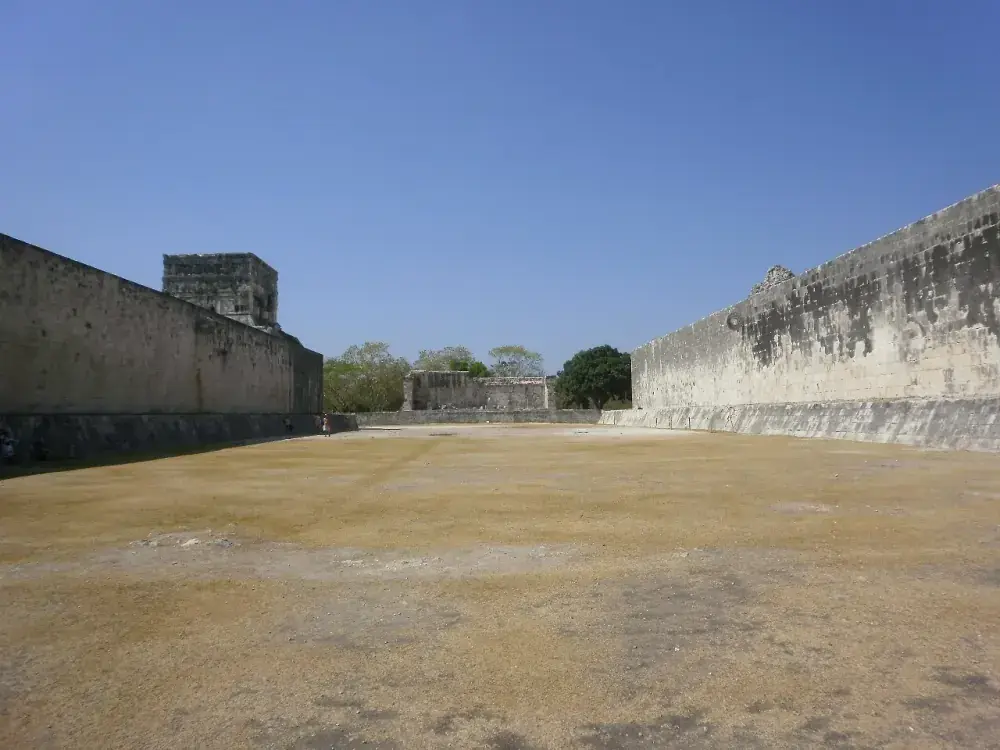
The Mayan Ball Game and the Great Ball Court at Chichen Itza
The Maya ball game, pok-ta-pok, was a ritual contest in which players moved a heavy rubber ball with hips and forearms, aiming at stone rings set high in the court walls. Chichen Itza holds the largest surviving court in Mesoamerica.
The Mayan ball game, known in Classical Maya as pitz and popularly as pok-ta-pok, was a sacred Mesoamerican team sport played for more than 3,000 years. Players used their hips to drive a heavy rubber ball across an I-shaped court, and in some games tried to pass it through a stone ring set high on the wall. The Great Ball Court at Chichen Itza is the largest ever built.
What was the Mayan ball game?
The Mayan ball game was a ritual team sport played across ancient Mesoamerica. The Classical Maya called it pitz, and the modern popular name pok-ta-pok imitates the sound of the ball. The Aztec played their own version, known as ullamaliztli, on a court they called tlachtli. Versions of the game date back more than 3,000 years, making it one of the oldest team sports on earth.
Far more than a sport, the game sat at the center of Maya religious and political life. It was played in dedicated stone courts at nearly every major city, including Chichen Itza, where the largest court of all still stands.
How was the Mayan ball game played?
The Mayan ball game was played by small teams, often two to seven players a side, who kept a solid rubber ball in motion using their hips, forearms, and thighs. Players could not use their hands or feet. The ball was heavy, weighing as much as 4 kilograms (around 9 pounds), and struck hard enough to bruise, so players wore padding on the hips, knees, and arms.
Points were scored when the opposing team failed to return the ball or let it touch the ground on their side. Passing the ball through the stone ring mounted high on the wall was so difficult that it was rare, and it won the game outright when it happened. The stone rings at Chichen Itza sit about 6 meters (20 feet) up the wall, which is why visitors sometimes mistake the court for an early basketball court, though the rings are vertical and the ball could not be touched by hand.
What did the ball game mean to the Maya?
For the Maya, the ball game re-enacted their creation story. In the Popol Vuh, the sacred Maya text, the Hero Twins play the game against the lords of Xibalba, the underworld, and defeat death itself. Every match echoed that cosmic struggle between life and death, day and night, and the movement of the sun.
The game was also a tool of power. Rival cities used high-stakes matches to settle disputes as a kind of proxy for war, and rulers staged games to display their standing. This blend of sport, religion, and politics is why the ball court, not just the temple, was one of the most important spaces in any Maya city.
Human Sacrifice and the Mayan Ball Game: What the Evidence Shows
Yes, some high-stakes ritual games ended in human sacrifice, though not every match did. The carved stone panels along the Great Ball Court at Chichen Itza show a ballplayer being decapitated, with serpents and vegetation sprouting from the neck as a symbol of fertility and rebirth. Everyday games between local teams were competitive sport; it was the ritual matches, tied to war and religion, that could end in death.
Scholars still debate whether the sacrificed player was from the winning or the losing side, and it likely varied by city and era. In many cases the victims were captured enemies or war prisoners played in a rigged, ceremonial match rather than ordinary athletes.
The Great Ball Court at Chichen Itza
The Great Ball Court at Chichen Itza is the largest ball court in ancient Mesoamerica, measuring about 168 meters (551 feet) long and 70 meters (230 feet) wide. Two parallel walls rise around 8 meters (26 feet) on either side of the playing alley, each carrying a single stone ring carved with intertwined feathered serpents, the sign of Kukulkan.
Six carved relief panels run along the base of the walls, showing teams of ballplayers and the sacrifice scene. At one end stands the North Temple, and overlooking the court from above is the Temple of the Jaguars. The court sits just steps from El Castillo at the heart of the site and was built around the 9th century AD, at the height of the city.
The acoustics of the Great Ball Court
The Great Ball Court is famous for its acoustics. A word spoken quietly at one end of the 168-meter court can be heard clearly at the far end, and a single clap produces a series of echoes off the parallel walls. Acousticians regard the effect as deliberate, part of a design meant to carry the voice of a ruler or priest across the whole arena during ceremonies.
Seeing the Great Ball Court today
The Great Ball Court sits near the main entrance of the Chichen Itza archaeological zone, a short walk from El Castillo, and is open to walk through on the ground. It is one of the finest structures across the Yucatan's Mayan ruins. Plan the site hours, tickets, and route on the Chichen Itza destination guide.